Sunday, 27 May 2012

Convenience Food

I spent Friday at a new site over the border into North Yorkshire not sure what to expect other than a super day in the sunshine. The site comprises both woodland, with a well fed stream, and open fields up and away from the valley.

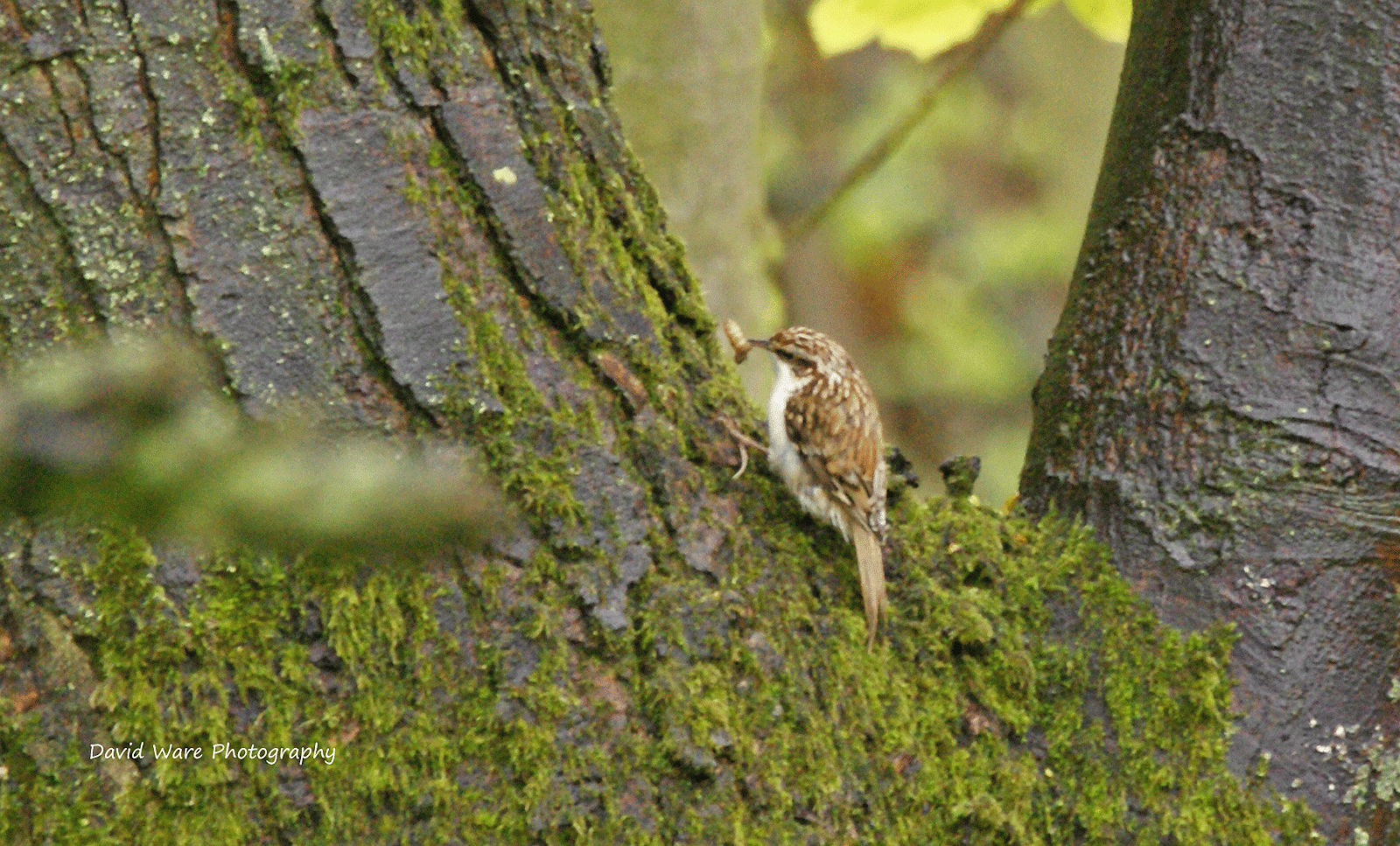
Much of what I saw in the woods was seen only fleetingly as the foliage is now becoming quite dense with the continuing fine warm weather. All the regular woodland species were seen or heard, including my third different pair of Marsh Tits in the space of a week. I use to think them quite uncommon, but now I am beginning to change my mind. I also came across yet another very obliging Treecreeper!! Visitors included Willow Warbler, Garden Warbler, and Chiffchaff.


Listening to a male Chiffchaff calling from the top of a tree, I was suddenly aware of a response coming from somewhere in a group of coppiced willows close to my position. The bird call was not familiar, and the bird didn’t show itself at all in the twenty minutes or so that I observed. My guess is that this may have been a female letting the male know that all was alright, but if you know differently then please leave a comment.

Up away from the wood where the trees thin and open farmland begins, I came across a terrific Tree Pipit singing from individual hawthorns before taking to the air and parachuting back with typically both feet dangling. All that flying and singing take energy. But why expend more energy catching food when it comes close enough not to have to move. So it was for this bird when a swarm of St Mark’ flies came wandering past. The Tree Pipit simply helped itself.


Wednesday, 23 May 2012

Out Came the Sun and Dried Up all the Rain...

With temperatures rising to the mid-20s all the bug life in the world came out to play. And with it, so the bird life woke anew.

I have been popping over to one of my favourite Wolds haunts on and off over the past few weeks primarily to check up on a pair of Redstart. It has also been a chance to see what else has survived the winter or returned from sunnier climes.
The Redstarts have returned, paired up, chosen a new nesting site, and judging by the frequency of visits back and forth, are in the process of raising a brood. The pair are a bit distant but have been affording some good views through bins. As the season progresses, I hope to get some closer shots.

Redstart

Restart
The more I visit this site the more I seem to find. One of my latest discoveries has been a pair of Marsh Tits. Distinguishing them from their Willow cousins is not always easy, but the distinctive call is so reminiscent of the “pchow” noise we made as kids when firing our toys guns. On this occasion I was able to spend a leisurely half hour watching them inspecting a row of hawthorn bushes for caterpillars and other bugs.

Marsh Tit

Marsh Tit
As the sun lowered to the horizon I spotted a lovely Song Thrush and Yellowhammer spotlighted at the top of a bush, singing their hearts out in search of partners. They say this weather is going to continue – I really hope they are right.

Treecreeper

Song Thrush

Yellowhammer

Monday, 21 May 2012

Golden Spurn

If you are a regular reader, you’ll know that I have this knack of turning up to see reported rarities after they have moved on – sometimes even hours after! I have come to think of myself as a bit of a ‘Jonah’ when choosing target species. Never one to give in to superstition, today I went off to Spurn hoping to see the reported Golden Oriole. The weather was not very inspiring with low cloud along the coast and strengthening north-easterly winds. But off I went; my enthusiasm steeling me against further potential disappointment.

I started my quest at Beacon Lane, where the bird – a first summer male – had been regularly seen. The Oriole’s nature is to seek dense cover or linger in the tops of trees. Those of you who know the area will know that there are very few tall trees at Spurn. So I was expecting fleeting glimpses if I was going to see anything at all.

After a couple of circuits, including a walk up one of the denser hedge boundaries, there was no sign of anything except Blackbirds, Dunnocks, an obliging Sedge Warbler, and a very hungry Whitethroat picking off the Brown-Tailed Moth caterpillars that were breaking out of their silky cocoons in their hundreds.
Emerging Brown-Tailed Moth caterpillars


Sedge Warbler

One hungry Whitethroat
So I decided to walk the ‘Triangle’ to see what else was around. The wind was keeping most things close to the ground, but I did find an obliging Skylark, a Wheatear, and a couple of Whinchats.
Skylark
I stopped in at Canal Scrape, but all was quiet. However, as I walked the path back to the Crown & Anchor I was treated to some really good views of a Cuckoo perched in a hawthorn overlooking the pond and canal. Given the lack of any calls, I’m guessing it was a female waiting for the Reed Warblers to give away the position their nest sites.

Cuckoo

Meadow Pipit with a hungry brood

Yellow Wagtail
Back to Beacon Lane for one final sortie. Still nothing – not even the Sedgie or Whitethroat! I was joined by two couples who had previously seen the Oriole. They commented that they had seen the bird at Sammy’s Point before it was reported at Spurn. I had had enough and decided to head home. Initially I was going to go to Patrington Haven, but changed my mind and went to Sammy’s Point on the off chance – and I am glad I did.

I had only been out of the car for a few minutes when a couple of horse riders came past. Suddenly there was a thrush-sized greenish bird flying towards me, diving into a dense bush of hawthorn near the car park. Could it have been the Oriole? I waited for a reappearance for what seemed like ages, but to no avail. Then, as a lady with three noisy dogs walked along the back of the horse pasture, there it was again. This time the Oriole offered some better, but still brief views as it moved from one hawthorn tree to another, before heading north towards Easington. Frustratingly I didn’t have the chance of a photo, but my view through the bins was good enough for a positive identification. The reputed likeness of immature birds to Green Woodpecker was not as strong as I expected. The back was green but paler; the breast a much paler yellow; and the rump also a much less vivid yellow. But a Golden Oriole it was, and means another tick on my list.
Hopefully this has now broken the ‘Jonah’ tag and I might enjoy more such good fortune over the rest of the summer.

Sunday, 20 May 2012

Tophill Delights

I don’t think I have ever seen as many Swifts as the throngs over ‘D’ and ‘O’ reservoirs on Friday. Whether the cold wind had driven the flies to much lower levels, I don’t know, but I felt that I was taking my life in my hands just walking around. Thank goodness for their fantastic flying skills - I came away without any bruises, but did hear the rustle of the wind on feathers as they whizzed past me!

The Swifts were accompanied by smaller numbers of Swallows and House Martins, and only a few Sand Martins. And following in their wake was a superb Hobby, first seen with Richard Hampshire on a low level sortie across ‘D’ reservoir (the bird, not us), and then again speeding across and in front of the hide on North Marsh. Much too fast for a photo though!
Two of my favourites were on view on Friday. First a lovely pair of Pintail on SME. Such elegant ducks, I could watch them all day. Hopefully they may be thinking of breeding on site this year.


My second favourites were the Goldcrests in ‘D’ woods. Their high pitched, yet quite melodic song seemed to be everywhere in the tops of the larch and pines. As I sttod patiently listening I was treated to occasional teasing sightings at lower levels. A few were hunting for bugs in the crevices of the bark, while one or two were clearly picking up nesting material. I have struggled all winter to get some decent shots of these tiny performers, but on Friday some of my patience was rewarded.


Friday, 11 May 2012

Don't Call Me Jonah!

This recent bout of rainy and showery weather has rather spoilt any opportunity to get out. Having spent most of the past week or so either at work or indoors, today I was determined to get out. Birdguides had been reporting a variety of migrants passing through, but one that seemed to have stuck in our area was the Atlas Flycatcher over at South Landing, Flamborough. I must admit to have felt a little hesitant about going to see a potential rarity; over the past months I have gone to find a number of specials only for them to have moved on before I arrived. However, Paul Hudson (our local TV meteorologist) had forecast light showers for most of the day, with a northerly breeze, so I reckoned that the bird had no real incentive to move on. On that basis South Landing was my chosen destination.

I arrived to find half a dozen others, but no sign of the bird. One of the locals reported that it had become more mobile over the past day or so, and had been seen at different points up and down the ravine alongside the car park. Despite this news my spirits remained buoyant; but at that point it started to rain. The shower lasted well over an hour, and I was drenched. The wind had picked up and things had turned decidedly chilly. I bumped into an old work colleague, and together we walked the circular path around the site.
There was no sign of the Atlas anywhere – probably driven into hiding because of the cold. After the rain there was plenty of other interest – a few Whitethroats, at least one pair of Spotted Flycatchers, a Lesser Whitethroat, and a pair Treecreepers passing grubs to each other.  All and others were looking for and finding things to eat - although none had found the mass of snails anchored on one tree. So why no Atlas Flycatcher? No-one around South Landing had seen it, so it seems that my bad luck continues. Next time perhaps I should not decide on a venue using Birdguides.

Even the Woodpigeons were cold

Song Thrush hunting worms

A cache of snails at least eight feet off the ground

Spotted Flycatcher

Treecreeper with a present for its mate

Treecreeper

Whitethroat

Lesser Whitethroat

Friday, 27 April 2012

Variations in Yellow - Follow-up

Just over a week ago I published a blog on the group of Yellowhammers that had begun visiting my garden. Those visits continue I’m glad to say, but the numbers and colour of those birds has changed noticeably in that time.

Firstly the group has increased in size to up to ten birds at a time. I haven’t seen that number of birds together in one go other than during the winter, and then in mixed flocks of finches. On recent occasions the Yellowhammers seem to have been in the company of Goldfinches and Chaffinches, so perhaps the congregation is a run-over from winter into spring?

The colour change has been quite dramatic, posing the question of whether this group is the same one I saw 10 days ago. Judging from their colour, the earlier birds I thought were a mix of male and female or juvenile. The colouring of the “new” birds would suggest that they are nearly all male. Now I’m not a greatly experienced birder, but I don’t think that birds can change plumage as much in just over one week; hence my belief that this second group is a different group.


So if there is a second group the next question concerns the total number of birds in the area. In my wanderings around the pathways and lanes around the village I have noticed numerous Yellowhammers atop the hedges singing to establish territories, but I have not noticed any groups of birds – indeed I can’t see those birds leaving territories to join a group to feed in my garden! So with the two groups there are nearly 20 birds above what I suspect is the resident population, and I suspect that I have witnessed a migration. Perhaps these birds came south when the weather turned snowy and cold in January, and they are only now moving back. I think I will have to do some research with the BTO.

Oh, I almost forgot, we also had a nice looking Stock Dove come for a feed.

Monday, 23 April 2012

Lincolnshire Delights

Today I went down to Lincolnshire on one of Michael Flower’s excellent trips (see Michael's blog). The target species was the Nightingale. We went last year at the same time and the selected site was stuffed to overflowing with passerine migrants – ten singing Nightingales, Garden Warblers, Blackcap, Chiffchaff, and Willow Warblers – so the expectation for today was high.

The weather today was not as good as a year ago. I took a look at the Met Office forecast for RAF Waddington (just up the road), and that suggested overcast conditions with a 20% chance of a shower. In fairness the forecast wasn’t too far wrong, but when the only shower arrived, it was a bit of a downpour. We all took shelter under the trees, protecting the camera equipment from the rain.
The Nightingales were certainly in aural evidence, although this year we counted only 5 singing males. A couple made themselves seen, but spent most of the time out of the way. The other warblers were also a bit in short supply. We didn’t hear one Garden Warbler, but there were several Blackcaps, Willow Warblers and Chiffchaff. Even the Swallows numbers were low. Some of this could have been the overcast conditions, but Michael told us of reports that many birds had been held up in their migration because of bad weather in Spain. Let’s hope it improves soon.
Chiffchaff

Willow Warbler
After lunch I went back to find the Nightingales again. One particularly took my interest, and I spent a good hour following it as it moved around its territory. Given the energy and volume this bird puts into its choral repertoires it is not surprising that it needs to refuel between performances. I watched as one bird sought out morsels in the undergrowth, occasionally coming to the edge of the hedging and into plain view on the paths. If only that had been more predictable, then I would have had some better photos. As it was I had to wait patiently for the bird to come to rest in its singing position.

Nightingale

Getting ready to sing

At full volume

Pausing before an encore

Just having a rest
I love these birds. They are master songsters, and are by no means as dowdy as some would describe their plumage to be. It is just such a shame that their territory does not extend just that bit further north into East Yorkshire. Come on climate change!!!